Biodiversity Under Threat: Climate Change, Environmental Challenges and the Future of Conservation in Bangladesh

 Biodiversity, meaning the variety of plants, animals, microorganisms, and ecosystems that sustain life on Earth, is rapidly becoming one of the most critical environmental emergencies of the 21st century. Nowhere is this crisis more acutely felt than in Bangladesh, a nation of remarkable biological wealth squeezed into one of the world’s most densely populated geographies. Globally, between 1970 and 2020, populations of large animals declined by an estimated 68 percent, according to the International Union for Conservation of Nature (IUCN). Of the Earth’s estimated eight million species, scientists warn that 12.5 percent could disappear within the coming decades if current trends continue. For Bangladesh, the numbers are, if anything, more alarming.
Two landmark studies led by IUCN Bangladesh and the Forest Department, supported by the World Bank, have revealed that 24 percent of animal species and 39.4 percent of plant species in Bangladesh face imminent extinction if no protective measures are taken. The country is home to 653 fish species, 566 bird species, 147 reptile species, 50 amphibians, 127 mammalian species, and 1,952 species of invertebrates a biodiversity richness that belies its small land area of roughly 147,000 square kilometres. As climate-related disasters grow more frequent and severe, conserving this natural inheritance is no longer merely an environmental objective but a matter of national survival.
Climate change remains the single greatest overarching threat to Bangladesh’s biodiversity. Rising temperatures, unpredictable rainfall, prolonged droughts, intensifying cyclones, and accelerating sea-level rise are dramatically rewriting the ecological map of the country. Sea levels around Bangladesh are rising at approximately 4.58 millimetres per year, and combined with land subsidence, this rate threatens to inundate vast stretches of the coastline. A projected rise of 45 centimetres by 2050 alone could flood 75 percent of the Sundarbans, while a rise of 50 centimetres could submerge 11 percent of the country’s total land area and displace as many as 15 million people. Under high-emission scenarios, sea levels could exceed one metre by 2100, threatening up to 20 percent of national territory.
The human dimension of this crisis is equally stark. A 2018 United States government report found that 90 million Bangladeshis, representing 56 percent of the population, live in areas classified as high climate exposure zones, with 53 million facing ‘very high’ exposure. Two-thirds of the entire country lies less than 15 feet (roughly 4.6 metres) above sea level, making it acutely vulnerable to the compound effects of tidal surges and intensifying storms. Surface water temperatures in the Sundarbans region have already risen by approximately 0.5 degrees Celsius every ten years in recent decades, disrupting breeding cycles, altering migration routes, and restructuring aquatic food chains.
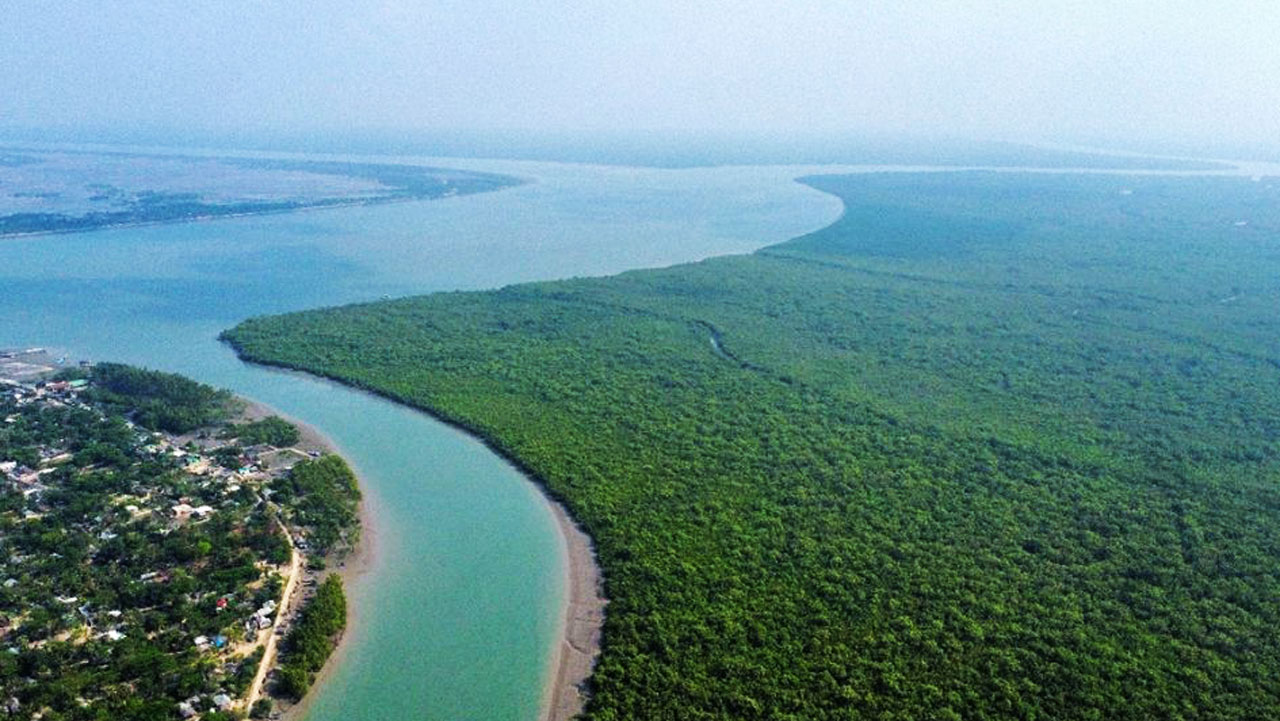
The Sundarbans, covering approximately 6,500 square kilometres on the Bangladesh side alone as part of the world’s largest mangrove forest spanning roughly 10,000 square kilometres across Bangladesh and India , stands as the single most significant natural shield protecting Bangladesh’s southwestern coast. It is a UNESCO World Heritage Site, a critical carbon sink, a nursery for marine species, and the last stronghold of the Royal Bengal Tiger. Yet this irreplaceable ecosystem is shrinking before our eyes.
Since 1970, the Sundarbans has already lost approximately 17,000 hectares, a combined result of rising salinity, tidal inundation, and human encroachment. Soil salinity in parts of the region has increased six times since 1984, and up to fifteen times in certain localities. By 2050, projections suggest that many parts of the Sundarbans will reach near-ocean-level salinity, rendering vast areas inhospitable to the mangrove species that underpin the entire ecosystem. Under a medium sea-level rise scenario, an estimated 9,599 hectares of mangrove area face permanent inundation by the end of the century. Under high-emission projections, up to 23 percent of the Sundarbans’ total area could be permanently flooded.
Amid this grim trajectory, there is one fragile note of hope: the Royal Bengal Tiger population in the Sundarbans showed modest recovery, increasing to 125 individuals in 2023–24, up from 114 recorded in 2018. Conservation experts caution, however, that this improvement means little if the habitat itself continues to contract.
Bangladesh’s wetlands, once numbering among the most extensive and ecologically productive in Asia, are disappearing at an alarming rate. Since 1990, the country has lost approximately 1.2 million acres of wetlands due to unplanned urbanisation, infrastructure expansion, and encroachment. The crisis is most visible in Dhaka, where nearly 60 percent of all water bodies vanished between 1980 and 2024. This destruction has contributed to a rise in urban temperatures of 3 to 5 degrees Celsius in the capital a heat island effect compounding the broader climate emergency. In the northwestern regions, more than 57 percent of wetlands disappeared between 1989 and 2020 alone, stripping communities of critical flood-control buffers and groundwater recharge zones.
The collapse of wetland habitats has had a devastating knock-on effect on freshwater fish biodiversity. According to a 2019 study, climate-driven changes in temperature, rainfall patterns, drought frequency, siltation, and flood timing caused an overall 21.25 percent decline in fish biodiversity over a decade. The losses were species-specific and severe: catfish populations fell by 27.27 percent; featherback species declined by a staggering 50 percent; loaches by 33.33 percent; and carp species by 16.67 percent. In total, 67 native fish species had previously vanished entirely from their natural habitats, though ongoing breeding programmes by the Bangladesh Fisheries Research Institute (BFRI) have so far revived 37 of these species.
The country’s major river systems are also under acute stress. The Ganges-Brahmaputra-Meghna river system deposits between one billion and 2.4 billion tonnes of silt every year, silting up riverbeds and wetlands and destroying spawning grounds. Across Bangladesh’s three main river basins the Barak-Meghna, the Brahmaputra-Jamuna, and the Ganges-Padma between 83 and 91.7 percent of fishers surveyed in a 2026 study reported observable declines in fish species diversity, reflecting a collapse in aquatic biodiversity that is being felt acutely in rural fishing communities.
Environmental degradation caused by human activity is accelerating an already grave biodiversity crisis. Rapid urbanisation, industrial expansion, deforestation, illegal logging, overfishing, excessive pesticide use, and plastic pollution are all bearing down on Bangladesh’s fragile ecosystems simultaneously. A recent survey of 3,060 respondents found that 42.2 percent had minimal knowledge of wildlife and biodiversity, while 26.4 percent reported no knowledge at all. This is a critical gap in public awareness that undermines community-level conservation. As of 2022, Bangladesh maintains 51 protected areas covering 10.72 percent of the nation’s forested land, but experts warn that protection on paper does not always translate to protection on the ground.
Agricultural intensification, while essential for feeding a population of over 170 million, has taken a heavy toll on natural habitats and native species. The excessive use of chemical inputs has poisoned aquatic systems and eroded the soil microbiome that underpins agricultural productivity itself. Meanwhile, public awareness surveys have found that respondents across the country report significant declines in species such as black bears, deer, vultures, and monkeys animals that were once common sights in rural landscapes. Respondents attributed these losses principally to deforestation and urban encroachment.
Bangladesh has constructed a legislative architecture for biodiversity protection that is more robust than many of its peer nations. The Bangladesh Environment Conservation Act 1995 provides the foundational framework for environmental protection. The Wildlife (Conservation and Security) Act 2012 strengthened legal safeguards for endangered species, prohibiting hunting, capture, and trade of protected wildlife. The country ratified the Convention on Biological Diversity (CBD) and has adopted a National Biodiversity Strategy and Action Plan (NBSAP) aligned with international commitments. Species-specific conservation action plans have been developed for vultures, tigers, elephants, dolphins, and sharks and rays, covering planning horizons through 2033.
The most recent legislative milestone is the Bangladesh Haor and Wetland Conservation Act 2026, which introduces fines of up to Tk 10 lakh and imprisonment for activities that damage wetland ecosystems. The Third National Faunal Red List has also been introduced to reassess the conservation status of wildlife species across the country. However, implementation remains the central weakness of the entire framework. Limited financial resources, weak enforcement capacity, persistent illegal wildlife trafficking, land encroachment, and insufficient public awareness continue to undercut what is, on paper, a comparatively ambitious policy regime.
Despite the scale of the challenge, biodiversity conservation offers Bangladesh a range of concrete and significant opportunities. Healthy mangrove forests protect coastal communities from cyclones and storm surges as demonstrated vividly when the Sundarbans’ buffering effect helped reduce casualties from Cyclone Remal in 2024 in the western coastal districts compared to the eastern impact zone. Ecotourism, sustainable fisheries, and ecosystem-service payments are creating new livelihood pathways that reward conservation rather than destruction. International climate and biodiversity funds present Bangladesh with a growing opportunity to invest in ecosystem restoration as part of its broader development agenda.
Bangladesh has already demonstrated internationally recognised leadership in climate adaptation; integrating biodiversity conservation into national development planning is a natural and necessary next step. Protecting natural ecosystems can generate employment, improve rural livelihoods, and advance progress towards the United Nations Sustainable Development Goals, particularly SDG 14 (Life Below Water) and SDG 15 (Life on Land).
The future of biodiversity in Bangladesh ultimately depends on whether the government, civil society, the private sector, research institutions, and local communities can act together with a sense of urgency proportionate to the crisis at hand. Climate change adaptation, sustainable land use planning, ecosystem restoration, renewable energy development, pollution control, and environmental education must all become central pillars of national policy, not aspirational additions to it.
Young people, educational institutions, and media organisations have a particular role in shifting the cultural narrative around nature. Biodiversity is not a luxury concern; it is the living infrastructure on which agriculture, fisheries, water security, public health, and climate resilience all depend. Bangladesh’s documented losses, including 67 fish species gone from the wild, 1.2 million acres of wetlands erased, 17,000 hectares of Sundarbans lost, and nearly 40 percent of plant species facing extinction, are not abstract statistics. They are the closing chapters of ecosystems that took millennia to form and cannot be rebuilt within a human lifetime. Whether those chapters represent a final warning or a turning point depends on the choices made today.